NCCR SPIN Qubits Winter School 2026
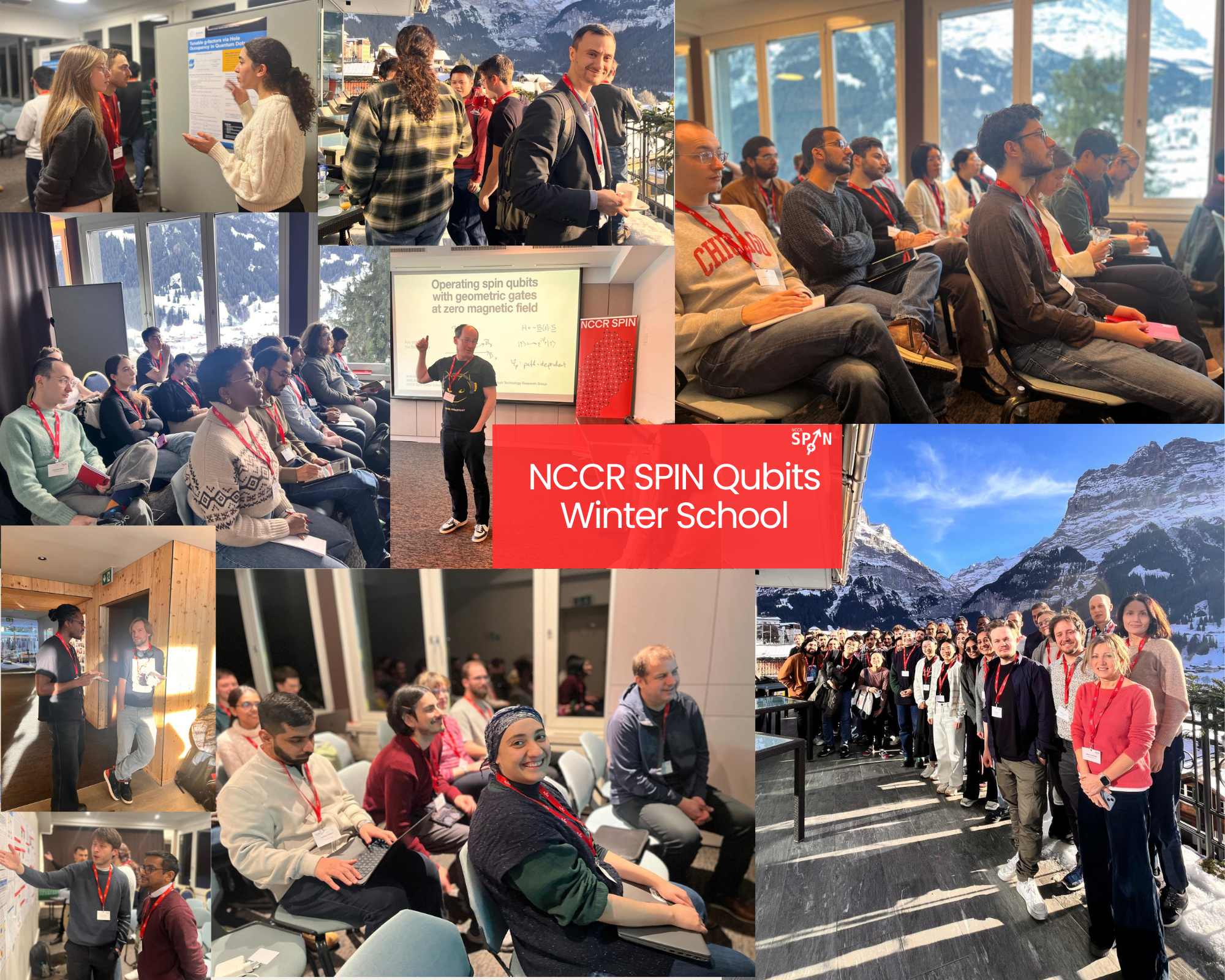
From 19–21 January 2026, NCCR SPIN hosted its bi-annual Qubits Winter School in Grindelwald, bringing together the young researchers for three days of intensive training, exchange, and networking in the field of quantum computation with semiconductor spin qubits.
The event gathered PhD students and postdocs from across the NCCR SPIN network and beyond. The scientific program covered theory, devices, control, and comparisons across quantum technologies.
Menno Veldhorst introduced quantum Ge devices, and Lars Schreiber discussed spin shuttling in semiconductor architectures. Fundamental aspects of qubit operation were addressed by András Pályi, who spoke on control, readout, and information-loss mechanisms in solid-state qubits, and Jelena Klinovaja, who provided insights into spin qubit theory. Eliska Greplova highlighted the role of AI approaches in spin quantum computing.
Additionally, Stefano Bosco spoke on semiconducting quantum computing, while Andreas Wallraff presented superconducting qubits and the landmark experiment demonstrating quantum tunneling in electrical circuits, recognized with the 2025 Nobel Prize. Anasua Chatterjee focused on feedback and control of quantum systems.
Interdisciplinary perspectives added further dimensions: James Wootton explored the role of quantum computing in the creative industries and Roman Lipski, the artist in residence at NCCR SPIN QuantArt program, provided insights into the connections between science and art.
Complementing the lectures, Stephan Meyer led an abstract-writing workshop, while flash talks, a poster session, and a networking reception provided young researchers with opportunities to discuss their work and receive valuable feedback from peers and lecturers.
The Winter School gave young researchers essential, in-depth insight into the field, providing valuable context to shape and advance their research.