

SPINnovate
NCCR SPIN Innovation Seed Grant
The SPINnovate Innovation Seed Grant is an exclusive initiative tailored to accelerate pioneering ideas stemming from your research within the NCCR SPIN or associated domains, driving their transformation into practical technology for quantum computing.
Should you have any inquiries or require additional information about the SPINnovate initiative, do not hesitate to reach out to Dr. Carmela Pietropaolo at carmen.pietropaolo@unibas.ch.
Overview
NCCR SPIN aims to accelerate technology advancements and facilitate the transition from research breakthroughs to commercial success in quantum computing. Through non-dilutive funding, SPINnovate supports researchers in developing prototypes, validating technologies, hiring talent, and preparing future spin-offs.
Funding Schemes
SPINnovate offers three funding schemes: Early-Stage Ideas Grants, Advanced Technology Grants, and SPINnovate Launch Grants. Together, these programs support projects at different stages of technological maturity and commercialization readiness.
SPINnovate Launch Awardee (2025)
One project was awarded the SPINnovate Launch Grant in 2025.
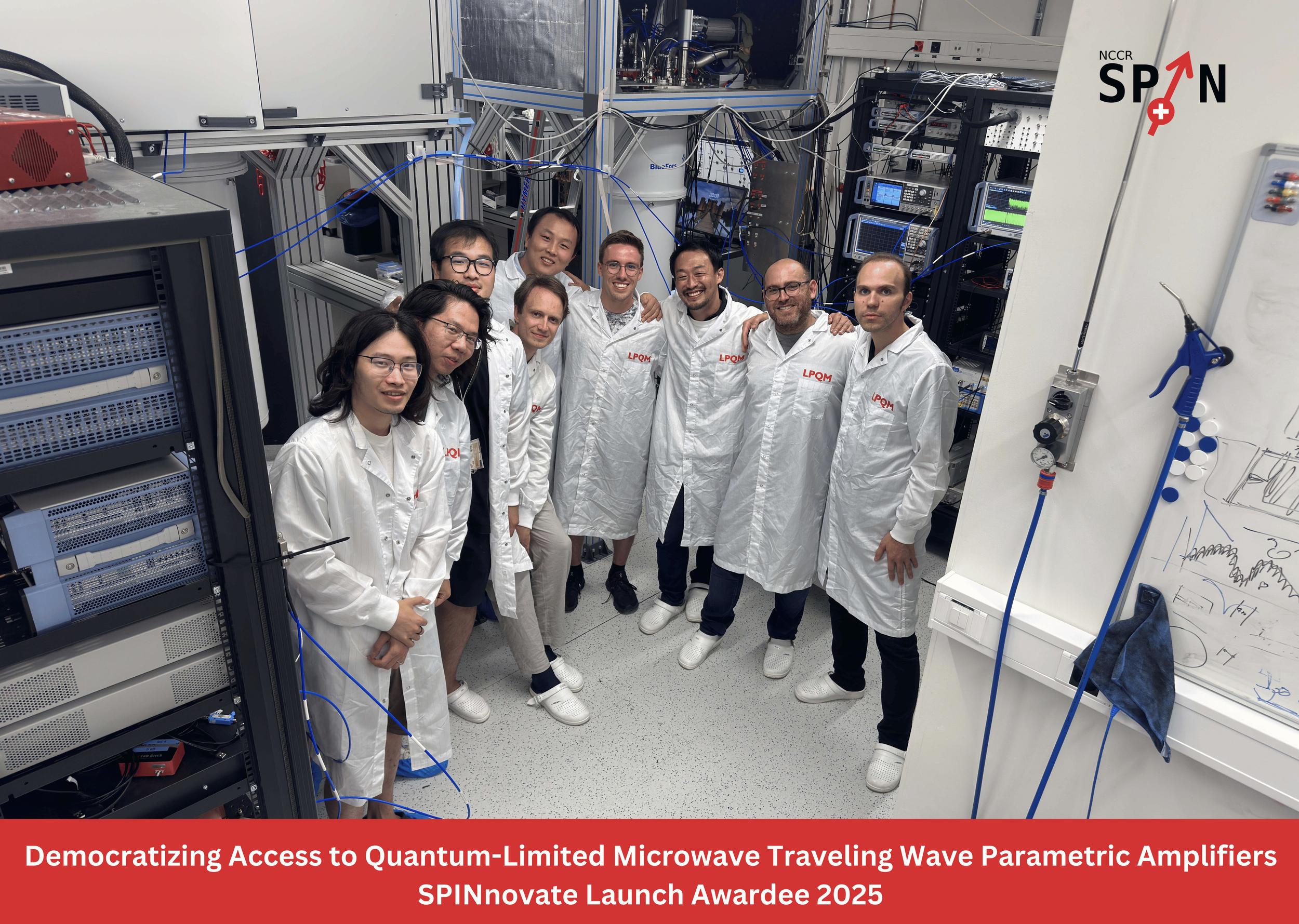
Democratizing Access to Quantum-Limited Microwave Traveling Wave Parametric Amplifiers
Left to Right: Xuxin Wang, Hao Li, Jiahe Pan, Evgenii Guzovskii, Jiaheng Wang, Hugo Arbez, Shingo Kono, Marco Scigliuzzo, Mahdi Chegnizadeh.
PI: Tobias Kippenberg
Quantum technologies are advancing rapidly, but their performance ultimately depends on how well fragile quantum states can be measured. In many leading quantum platforms, including spin-based and superconducting systems, the information stored in a quantum device is converted into an extremely weak microwave signal at cryogenic temperatures. Before this signal reaches room-temperature electronics, it must be amplified with minimal added noise; otherwise, valuable quantum information can be lost. This makes cryogenic microwave amplification a critical technology for scalable quantum hardware. Travelling-wave parametric amplifiers (TWPAs) are particularly promising because they can provide broadband, quantum-limited amplification, enabling faster and high-fidelity readout. In our group, we develop TWPA-based solutions for quantum computing applications. With the support of the NCCR SPIN seed grant, the team aims to advance and validate practical amplifier hardware that improves signal quality, reduces measurement bottlenecks, and supports cleaner, faster, and more reliable measurements in cryogenic quantum platforms, while taking important steps toward future commercialization
SPINnovate Second Call Awardees (2024)
Two outstanding projects were selected during the second call for their scientific excellence, market potential, and strong implementation strategies.
QanovaTech – Advanced Technology Grant

From left to right, standing: Simone Frasca, Marius Bild, Aleksandra Pac, Hon-Ming Yip
From left to right, sitting: Camille Roy, Antoine Silvin, Philippine Milward
The team behind QanovaTech.
Quantum computing holds immense promise, but it also presents unique technical challenges, particularly in managing and interpreting the ultra-small signals critical to its operation. Existing amplifiers add noise and can be limited to specific frequency ranges – reducing the accuracy of the quantum calculations. Secondly, the intricate packaging required for quantum systems demands specialized engineering. As a result, researchers often spend a lot of time solving these engineering problems, instead of focusing on their experiments.
Qanova Tech’s goal is to address these issues by producing TWPAs (Traveling-Wave Parametric Amplifiers) which introduce the minimal amount of noise allowed by the laws of quantum physics, and developing multipurpose packaging solutions based on several years of experience in the field. This allows researchers to work with clearer, more precise signals. The amplifiers are also more versatile, functioning across a range of frequencies, making them suitable for many different experiments and setups. Qanova Tech’s aim is to allow effortless system integration to ensure researchers involved in the quantum race spend their time advancing quantum technology.
The SQUID – Early-Stage Ideas Grant Awardee

From left to right: Antonia Weber, Timur Weber, Daniel Jetter, the team behind THE SQUID
An important current challenge in the field of experimental quantum computation lies in making the transition from realizing few-qubit devices to scaled-up quantum processors comprising the large numbers of qubits required to run useful quantum algorithms and quantum simulations. For solid-state qubits, such as spin qubits or superconducting qubits, the success of this transition relies heavily on advances in the material aspects of the qubit platforms. Issues such as defect-related decoherence, qubit inhomogeneity, and spurious cross-talks, become excessively problematic for large qubit arrays. There is therefore a great need in characterizing and visualizing, as well as mitigating, the sources of these issues. Spatial characterization of local magnetic fields and field gradients, spurious currents, and hotspots of dissipation through scanning probe microscopy will therefore be an important tool in advancing quantum computation.
Most nanoscale magnetic imaging tools at low-temperatures are fragile and expensive or limited in their performance. The SQUID combines excellent tip-sample distance control with an extremely sensitive magnetic imaging sensor. The team recently managed to optimize fabrication and demonstrated the sensor’s magnetic sensitivity, spatial resolution, and robustness. In the next phase, they are going to further improve the imaging performance towards a market-ready state followed by the founding of a start-up. The company will provide sensors for high-performance magnetic imaging at low temperatures and allow for an increasing throughput of quality control studies of qubit devices and supporting elements.
SPINnovate First Call Awardees (2023)
The inaugural SPINnovate call supported pioneering projects with strong potential to advance quantum technologies and create commercial impact. In its quest to bolster technological advancements and expedite the transition from groundbreaking research to commercial viability, NCCR SPIN opened in 2023 the SPINnovate grant offering up to CHF 75,000 in non-dilutive funding per project. This grant opportunity, marked a significant milestone during the 4th year of the NCCR, and aimed to empowering initiatives within NCCR SPIN institutions, focusing on spin-off endeavors. Eligible activities encompassed personnel recruitment, prototype development, and other spin-off-related ventures.
Quamplify

From left to right: Miguel José Carballido, Rafael Eggli, Tara Patlatiuk, the team behind Quamplify
In the field of quantum computing, scientists utilize specialized sensors to detect minuscule radio-frequency signals originating from qubits. These signals play a pivotal role in understanding the behavior of the qubits. In order to ensure precise measurements, the signals are conditioned and amplified at extremely low temperatures, positioned in close proximity to the qubits. This setup effectively diminishes unwanted background noise, thereby enhancing measurement accuracy.
The key component enabling this process is cryogenic amplifiers and other components designed to operate optimally in cold environments. However, current devices exhibit limitations with regards to their noise performance and resilience to magnetic fields, sparking considerable interest in exploring alternative solutions.
Quamplify’s mission is to develop cryogenic radio frequency electronic components utilizing quantum paraelectric perovskite materials as a core technology. These devices significantly enhance signal strength while maintaining minimal background noise levels. Moreover, they demonstrates resilience to external factors such as magnetic fields and extreme cold, offering a distinct advantage over traditional technologies. As such, Quamplify has the potential to revolutionize the landscape of quantum computing!
qprobe

From left to right: Richard Warburton , Andreas Kuhlmann, Sascha Martin, the team behind qprobe
qProbe is designed for rapid and precise testing of solid-state quantum hardware, particularly semiconductor-based qubits, at very low temperatures. Operating quantum devices at very low temperatures is essential for quantum computing and requires efficient testing at low temperatures to drive progress. cryoProbe makes this possible through a specialized cryogenic probe station designed to meet the unique demands of quantum hardware. A key advantage is the probe station’s compact dimensions, allowing it to fit into standard cryogenic magnet systems. This compatibility means it can be used with cryostats commonly found in research labs, significantly reducing the acquisition costs and making it a valuable tool for a wider range of users.