
Introducing Prof. Dr. Christophe Piveteau, the new Tenure Track Assistant Professor of Theoretical Quantum Computing at the University of Basel
Prof. Dr. Christophe Piveteau has been appointed as the new tenure track assistant professor of theoretical quantum computing, a position created by the NCCR SPIN at the Department of Mathematics and Computer Science at the University of Basel, beginning on February 1, 2027.
The role of education is shifting in the wake of rapid technological advances, in particular AI. As solutions to difficult problems become more accessible to researchers, “the education of PhD students and the generation of research output are now two tasks which are not entirely aligned” Piveteau observes. In this context, he believes that comprehensive academic supervision must rise to the challenge by conscientiously providing high-quality training for critical thinking; navigating a competitive academic landscape; and maintaining flexibility and creativity in research.
Piveteau is prepared to rise to this challenge with a diverse linguistic, cultural, and educational background. His double bachelor degrees in physics and mathematics from ETHZ set the stage for masters in physics with a research project at IBM Zurich in machine learning and AI. His PhD research was carried out in the group of Quantum Information Theory at ETHZ. Following the PhD, he secured a PostDoc position in Quantum Error Correction at INRIA in Paris. He naturally gravitated towards quantum computing to be professionally engaged at the intersection of computer science, mathematics, and physics.
A research stay at IBM Laboratories in Yorktown Heights during his PhD was a key moment in Piveteau’s professional life, as it sparked his interest in topics beyond his educational experience during his PhD and inspired his most recent appointment as a Research Scientist at IBM Zurich. His transition into a professorship will maintain his research activities while fulfilling his desire to teach.
“Teaching is one of the most stimulating experiences”, Piveteau says, “when you have something you are very passionate about and you have motivated students that are also interested in the same things”. His educational goals extend beyond the classroom into supervision, stating that he wants his academic legacy to include pivotal career support to researchers in his group.
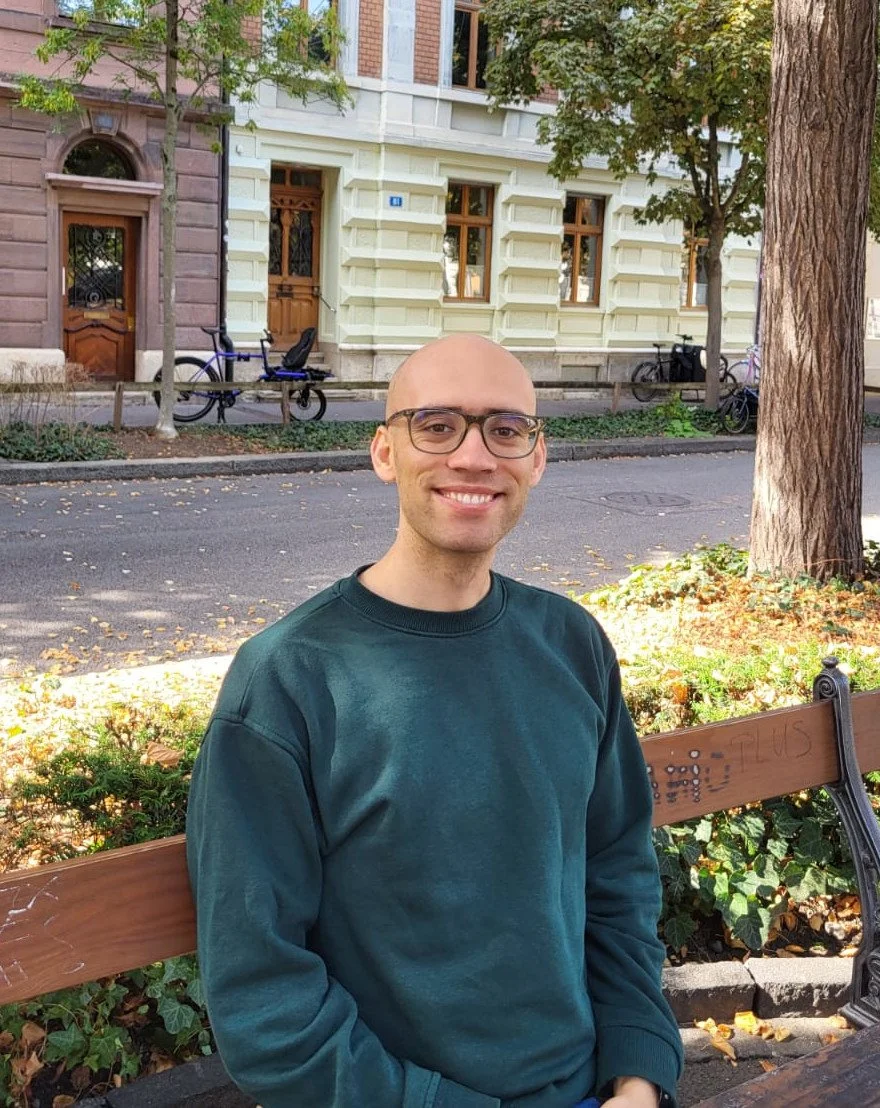
Prof. Dr. Christophe Piveteau
“As a theorist, the key motivation for us is to understand what really underlies the computational advantage of quantum computers.”
In regards to his research, Piveteau remarks that “as a theorist, the key motivation for us is to understand what really underlies the computational advantage of quantum computers.” In deciding which research problems to pursue, he searches for opportunities to uncover mathematical elegance in the underlying framework in questions that have some urgent technological application.
Piveteau is particularly interested in the intersection of two fields: Quantum algorithms and error correction. Error correction is concerned with the reliable storage, transmission and processing of information using unreliable classical or quantum devices. It underlies much of our modern technology, enabling the transmission of data over communication systems such as Wi-Fi or 5G.
Quantum error correction and quantum algorithms exhibit a rich connection. One the one hand, error correction techniques are essential to enable reliable quantum computation on noisy devices. On the other hand, certain mathematical techniques that were originally developed for error correction have led to new approaches how to design quantum algorithms themselves. Piveteau studies these connections, with the goal of advancing both fields.