
Quantum silicon is making waves
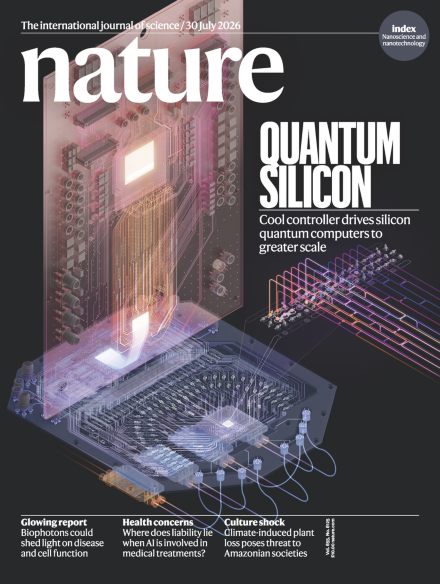
This week’s issue of Nature (29 July 2026) features quantum silicon on its cover, and for good reason.
Two papers in the issue report major breakthroughs moving spin qubits from underdog to leading contender. They address one of the most important questions in semiconductor quantum computing: how can high-performance spin qubits be scaled into larger, integrated systems?
The studies approach this challenge from different directions. The Hughes Research Laboratories (HRL) Quantum Team focuses on cryogenic control and system integration, while a team led by researchers at QuTech, TU Delft, uses a mobile spin qubit to create flexible connections between stationary qubits.
Together, the results show a field moving beyond the performance of individual qubits towards the architectures, control systems and error-correction measurements needed to scale up.
One of the largest obstacles to scaling a cryogenic quantum computer is wiring. Qubits operate at millikelvin temperatures, whereas their control electronics usually operate at room temperature. Every control line must therefore cross a temperature difference of almost 300 kelvin. As the number of qubits grows, this arrangement becomes increasingly difficult to manage.
The HRL Quantum team, with a long-standing focus on spin qubits, demonstrated an alternative. Its system combines a silicon quantum chip with a digitally programmed CMOS controller operating at 4 kelvin. A high-density superconducting ribbon cable carries signals to the qubits at millikelvin temperatures while limiting the flow of heat. Their quantum chip contains 54 quantum dots and can be configured to host up to 18 exchange-only qubits. Using the integrated system, the researchers demonstrated high-fidelity single- and multiqubit operations and performed repeated syndrome-measurement rounds for repetition and quantum error-detecting codes.
The result is more than a larger qubit device: it shows how a quantum chip, its control electronics and the connections between them can function as a scalable system.
The QuTech-led team approached scaling from another direction: connectivity. Qubits must interact to perform computations and detect errors. Directly connecting each qubit to many neighbours, however, creates an increasingly dense and complicated device. The team instead used a mobile ancilla qubit, shuttling it along a silicon channel and connecting it sequentially to four stationary data qubits. This created an effective five-qubit processor capable of performing weight-four parity checks. The team also generated genuine five-qubit entanglement.
At NCCR SPIN, the Swiss National quantum-computing program supported by the Swiss National Science Foundation, research has been fully focused on spin qubits since the beginning of the program in 2020. We have been making numerous contributions to the field since then, so these breakthroughs have particular significance for our community.
In 1998, Daniel Loss and David DiVincenzo, co-director and advisory board member of NCCR SPIN, respectively, published their foundational proposal for quantum computation using spins confined in semiconductor quantum dots. The Loss–DiVincenzo proposal founded the field of spin-qubit research.
Nearly three decades later, many of the questions raised by that vision have become technological challenges: how to manufacture spin qubits reproducibly, preserve their coherence, connect them across a processor and control them at scale.
The latest Nature results demonstrate solid progress on these fronts.
The same week also brought a major industrial signal. Shortly before the papers appeared, IBM announced an agreement to acquire HRL Laboratories. The acquisition highlights the growing strategic interest in silicon spin-qubit technology. IBM Research Zurich is a partner in the NCCR SPIN network, making this development especially relevant to our community.
Recent work within NCCR SPIN addresses complementary parts of the same path towards scalable quantum processors.
In Theory of spin qubits and the path to scalability, Zoë McIntyre, Abhikbrata Sarkar (University of Basel) and Daniel Loss review the theoretical foundations of different spin-qubit implementations and examine approaches to long-range coupling, including spin shuttling, now demonstrated in the QuTech processor.
An imec–ETH Zurich collaboration led by Klaus Ensslin and Thomas Ihn has demonstrated a silicon spin qubit fabricated in a 300-mm industrial foundry with a Hahn-echo coherence time of 4 milliseconds. The result combines long qubit coherence with the industrial fabrication processes needed for reproducible manufacturing at scale.
James Wootton, from Moth Quantum, and his collaborators have also introduced a QPU-scale randomized-benchmarking method based on Bell-pair injection. Demonstrated on 156-qubit IBM processors, the method is designed to reveal correlated errors and identify the circuit depth beyond which basic error-mitigation strategies can be expected to fail. Such processor-wide diagnostics will become increasingly important as quantum systems grow.
No single experiment settles the race among quantum-computing platforms. But the Nature cover, recent advancements and industrial commitment make one point clear: the spin-qubit underdog has become much harder to overlook.
Further reading
Underdog ‘spin qubits’ leap forward in race to a useful quantum computer
A digitally controlled silicon quantum processing unit
Weight-four parity checks in a spin-shuttling architecture
How silicon-chip technology is being re-engineered for quantum computing
Quantum computation with quantum dots
Theory of spin qubits and the path to scalability
Long coherence silicon spin qubit fabricated in a 300-mm industrial foundry